Yo, what’s up everyone! I’m a supplier of copper wire, and today I wanna chat about how temperature affects the resistance of copper wire. It’s a pretty cool topic, and it’s super important for anyone who uses copper wire in their projects. Copper Wire

Let’s start with the basics. Resistance is a measure of how much a material opposes the flow of electric current. In the case of copper wire, the resistance depends on a few factors, like the length of the wire, its cross – sectional area, and of course, the temperature.
You see, copper is a metal, and metals are made up of atoms. These atoms have a bunch of free electrons that can move around. When an electric current is applied, these free electrons start to flow through the wire. But as they move, they bump into the atoms in the wire. These collisions slow down the electrons, and that’s what causes resistance.
Now, let’s talk about temperature. When the temperature of the copper wire goes up, the atoms in the wire start to vibrate more. They get all jittery, and those vibrations make it harder for the free electrons to move through the wire. Think of it like trying to walk through a crowded room. If the people in the room are just standing still, it’s easy to get through. But if they’re all jumping around, it’s a lot more difficult.
As the temperature increases, the resistance of the copper wire also increases. This relationship is pretty linear over a certain temperature range. We can use a formula to describe it. The formula is (R_T = R_0(1+\alpha(T – T_0))), where (R_T) is the resistance at temperature (T), (R_0) is the resistance at a reference temperature (T_0), and (\alpha) is the temperature coefficient of resistance. For copper, (\alpha) is approximately (0.00393/^{\circ}C).
Let me give you an example. Suppose we have a copper wire with a resistance of (10) ohms at (20^{\circ}C). If we increase the temperature to (100^{\circ}C), we can calculate the new resistance using the formula. First, we have (T_0 = 20^{\circ}C), (R_0 = 10) ohms, (T=100^{\circ}C), and (\alpha = 0.00393/^{\circ}C).
[
\begin{align*}
R_T&=R_0(1+\alpha(T – T_0))\
&=10\times(1 + 0.00393\times(100 – 20))\
&=10\times(1+0.00393\times80)\
&=10\times(1 + 0.3144)\
&=10\times1.3144\
&=13.144\text{ ohms}
\end{align*}
]
So, as you can see, the resistance has increased from (10) ohms to about (13.14) ohms just because we raised the temperature.
This change in resistance due to temperature can have some real – world implications. For example, in electrical circuits, if the temperature of the copper wires changes, the resistance of the wires changes. This can affect the performance of the circuit. If the resistance increases too much, it can cause a drop in voltage, and the devices in the circuit might not work properly.
In power transmission, copper wires are used to carry electricity over long distances. The temperature of these wires can change depending on the weather and the amount of current flowing through them. If the temperature gets too high, the resistance of the wires increases, and more energy is lost as heat. This is a big deal because it means less power is actually delivered to the consumers.
On the other hand, in some applications, we can use the temperature – resistance relationship of copper wire to our advantage. For example, in temperature sensors, we can measure the resistance of a copper wire and use it to determine the temperature. Since we know the relationship between resistance and temperature, we can calculate the temperature based on the measured resistance.
As a copper wire supplier, I know how important it is to understand these things. When customers come to me looking for copper wire, I need to be able to tell them how the wire will perform under different temperature conditions. I also need to make sure that the wire I supply can handle the temperature ranges that the customers will be using it in.
We test our copper wires in different temperature environments to make sure they meet the required standards. We want to provide our customers with high – quality copper wire that will work well no matter what the temperature is.
If you’re in the market for copper wire, whether it’s for a small DIY project or a large – scale industrial application, it’s crucial to consider the temperature – resistance relationship. You don’t want to end up with a wire that won’t work properly because of temperature changes.
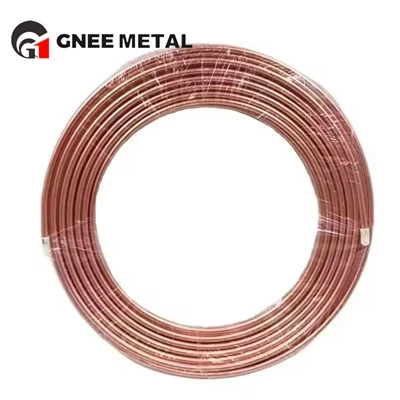
So, if you have any questions about copper wire and how temperature affects its resistance, or if you’re interested in purchasing copper wire from us, don’t hesitate to reach out. We’re here to help you make the right choice for your project.
Copper Bar References:
- Physics textbooks on electricity and magnetism
- Industry standards and specifications for copper wire
Gnee Steel (Tianjin) Co., Ltd.
Gnee Steel (Tianjin) Co., Ltd. is one of the leading copper wire manufacturers and suppliers in China. We warmly welcome you to buy discount copper wire for sale here from our factory. All our products are with high quality and competitive price. Contact us for more cheap products.
Address: No.4-1114, Beichen Building, Beicang Town, Beichen District, Tianjin, China
E-mail: sales@gneemetal.com
WebSite: https://www.chinacopperalloys.com/
